
Samurai Sudoku - Rules & Guide
What is Samurai Sudoku?
Samurai Sudoku (also known as "Gattai-5") is one of the most famous and popular multi-disk Sudoku variations in the world. Its shape presents a huge "X" shape, made up of 5 standard 9x9 classic Sudoku grids: one in the center, and the other four are located in the four corners of the central Sudoku, forming a partial overlap.
No sub-Sudoku can be solved in isolation, they are interdependent, and all 5 Sudokus together form a huge puzzle with a unique solution.
Basic rules
- Standard Sudoku Rules: The entire huge puzzle can be clearly split into 5 complete 9x9 sub-Sudoku boards. You must ensure that each of the 5 sub-disks contains the numbers 1 to 9 in each row, column and 3x3 thick-line grid without repetition.
- Four shared 3x3 squares: The four corners of the central Sudoku (i.e. the four 3x3 squares in the upper left, upper right, lower left and lower right) overlap with the corners of the four outer Sudokus. The numbers filled in these four overlapping grids (a total of 36 grids) must satisfy the dual rule constraints of the central Sudoku and the corresponding peripheral Sudoku.
How to solve problems and practical skills
Tip 1: Overlapping squares are the "portal" of information
These four overlapping 3x3 grids are the key to solving Samurai Sudoku. When you derive a number in the outer Sudoku and fill in the overlap, that number immediately becomes a known condition in the Central Sudoku; and vice versa. You need to constantly use these "portals" to pass puzzle-solving clues between 5 independent but connected boards.
Tip 2: The unique advantages of the center disk
The 9x9 Sudoku board in the center is particularly special because it has four corners that are connected to other boards. This means it is the area of the heart that receives the most external cues and radiates them the fastest. When the peripheral board is in a deadlock, trying to concentrate firepower to break through the central board can often achieve the effect of "moving the whole body with one move".
Tip 3: Long-term crossing elimination method
Although the boards are staggered, since each 9x9 board still follows the standard row and column exclusion rules, you can perform long line scans across the boards. For example, if you want to fill in a number in the overlapping area of the upper left Sudoku, you not only have to look at the constraints of the upper left Sudoku itself, but also scan along the row or column corresponding to the central Sudoku to see if it has been excluded by the known numbers at the far end of the central Sudoku.
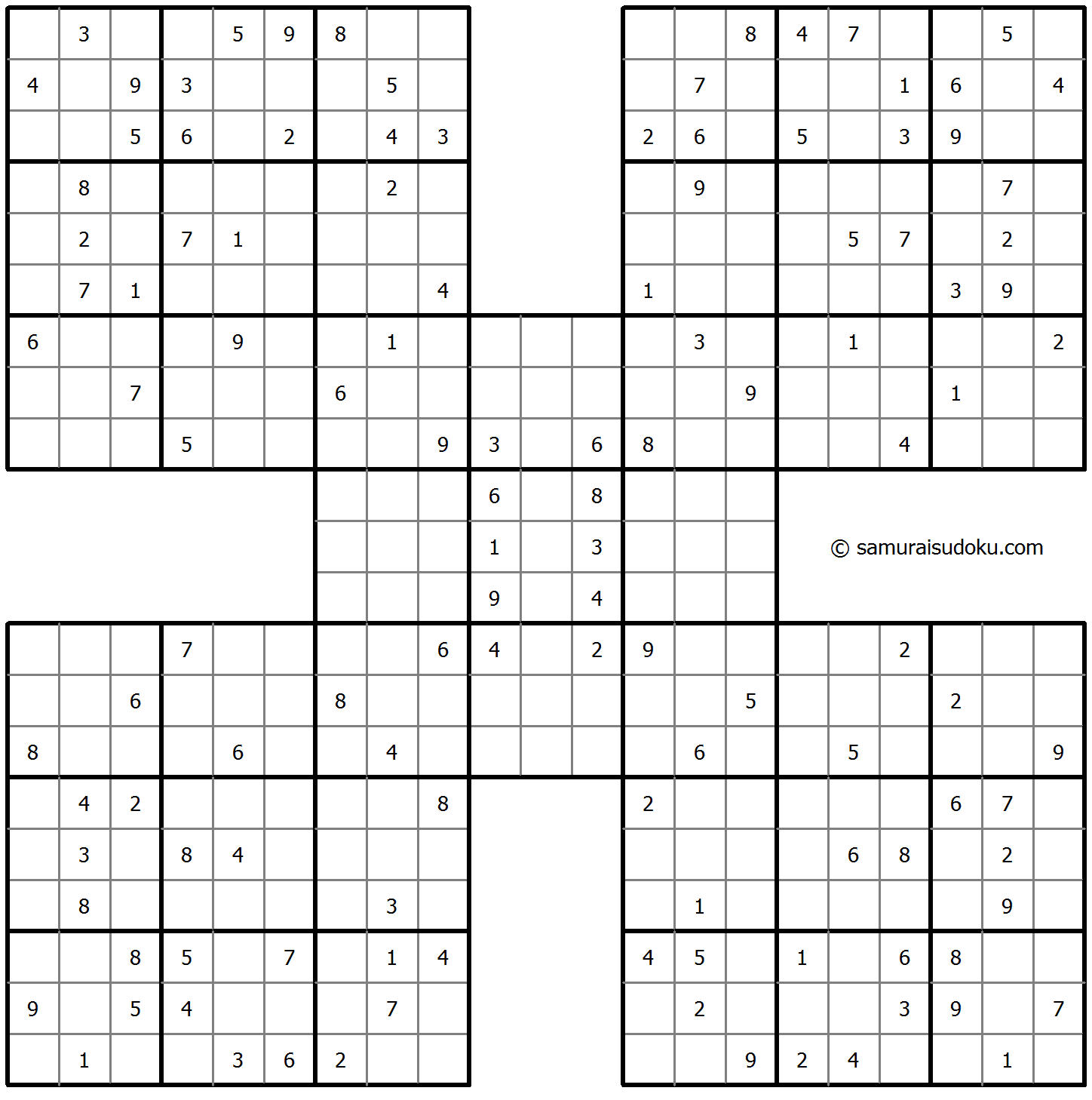
Example image: observe the 3x3 overlap area of the central disk and the four peripheral disks
Frequently Asked Questions (FAQ)
Q: Can I fill in all the disks in the upper left corner first, and then solve the other ones?
A: Almost impossible. Samurai Sudoku was designed so that the initial clues for each sub-board were extremely scarce. Any 9x9 board could not be solved independently due to insufficient information. You have to shuttle back and forth among the 5 boards, pushing wherever there is a breakthrough, and piecing together all the fragmented clues.
Q: In addition to the overlap in the corners, are there direct connections between the four outer Sudokus?
A: No. The four outer 9x9 Sudokus do not overlap in space, nor do any of their rows run through them. The only connection between them is that they must pass through the fifth Sudoku in the center to transfer and interact with clues.
Play Samurai Sudoku
Browse all puzzles or start with this sample puzzle.
English | 中文(简体) | 中文(繁體) | 日本語 | 한국어 | Français | Deutsch | Español | Português | Русский | Italiano | Nederlands | Türkçe | हिन्दी | ไทย | Tiếng Việt | Bahasa Indonesia | Polski | Українська |
数独 | Cool Sudoku | 数独 | Sudoku Puzzle | 賢くなるパズル | Free Printable Sudoku Puzzles
© samuraisudoku.com All rights reserved 2019-2026