
Butterfly Sudoku - Rules & Guide
What is Butterfly Sudoku?
Butterfly Sudoku is a very beautiful multi-disk variant of the classic Sudoku. It looks like a butterfly spreading its wings and is composed of four intertwined 9x9 classic Sudoku grids (located on the upper left, upper right, lower left, and lower right).
These four sub-disks are closely connected and have a large amount of overlap in the central area, so they require a high degree of mutual cooperation and linkage during the problem-solving process, which makes it much more fun than solving four ordinary Sudoku alone.
Basic rules
- Standard Sudoku Rules: The entire puzzle, although it may look huge, is essentially just 4 standard 9x9 sub-Sudokus. You must ensure that within each of the four 9x9 sub-disks, each row, column and 3x3 thick grid contains the numbers 1 to 9 without repetition.
- Deep overlap sharing: The four sub-disks overlap a large area in the central area. The numbers filled in any grid located within these overlapping areas must simultaneously satisfy the rule constraints of all 9x9 sub-boards it spans, and must not cause a number conflict in any associated board.
How to solve problems and practical skills
Tip 1: Keep an eye on the “torso”—the core overlap area
The intersection of the four disks (usually a large area consisting of four 3x3 grids in the center of the disk) is the torso of the entire "butterfly", which is a common area belonging to all four disks! Any number filled in here will produce a great repulsive force on the surrounding disk in all directions at the same time. This is the strategic location with the densest information and the easiest place to find a breakthrough.
Tip 2: Leverage the independence of edge “wings”
The outer corners of the four disks (the outer edges of the four wings of the butterfly) are their own unique areas and do not overlap with other disks. After you determine the numbers in these independent areas, you can use the standard Sudoku row and column elimination method like firing a laser to force the determined numbers to the internal overlapping areas, and then squeeze out the candidate numbers in the overlapping areas.
Tip 3: Avoid “working behind closed doors”
Since the four disks are highly intertwined, it is almost impossible for you to "solve the upper left corner alone first, and then solve the upper right corner." The problem-solving process of Butterfly Sudoku must be a global linkage - a number you derive on the board on the left may instantly become the only key to unlock the adjacent board on the right, or even the diagonal board. Be sure to keep a big picture view at all times.
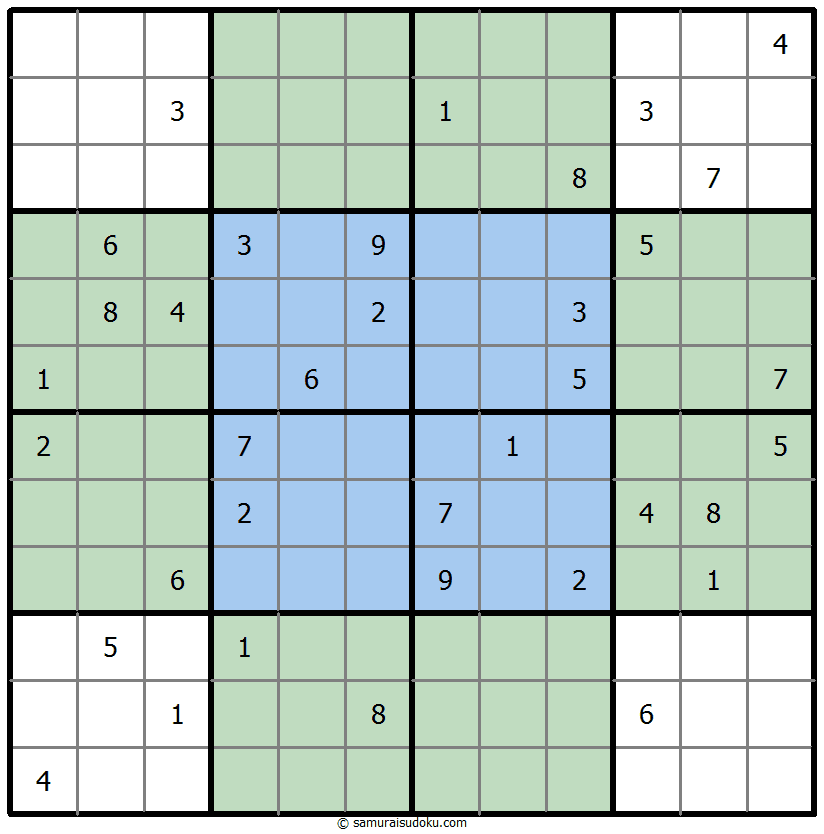
Example image: observe how four 9x9 disks overlap each other
Frequently Asked Questions (FAQ)
Q: Do these 4 sub-disks have independent solutions?
A: Absolutely not. They are tightly locked together as a whole. Because of the overlap, any clues that can be used on a single disk are incomplete and cannot be solved independently. These four boards are interdependent and must be advanced at the same time. Together they form the only solution to this puzzle.
Q: Do the numbers filled in the overlapping area need to be added, subtracted, multiplied and divided?
A: Not required. Butterfly Sudoku and Samurai Sudoku are just "overlapping areas in space". You only need to simply ensure that the numbers filled in the overlapping grids can simultaneously satisfy the "no duplication of the same row, column, and palace" rules of the 9x9 boards to which it belongs, without any arithmetic operations.
Play Butterfly Sudoku
Browse all puzzles or start with this sample puzzle.
English | 中文(简体) | 中文(繁體) | 日本語 | 한국어 | Français | Deutsch | Español | Português | Русский | Italiano | Nederlands | Türkçe | हिन्दी | ไทย | Tiếng Việt | Bahasa Indonesia | Polski | Українська |
数独 | Cool Sudoku | 数独 | Sudoku Puzzle | 賢くなるパズル | Free Printable Sudoku Puzzles
© samuraisudoku.com All rights reserved 2019-2026