
Windmill Sudoku - Rules & Guide
What is Windmill Sudoku?
Windmill Sudoku is a large variation of five standard 9x9 Sudoku boards. As its name suggests, these five disks are arranged like the four blades of a windmill surrounding a central axis, presenting a unique rotational symmetry.
In this variant, the four outer Sudoku boards (windmill blades) do not just overlap at the corners like the Samurai Sudoku, but overlap with the central Sudoku in a "dislocated" manner to create a larger area of strips. No single board can be solved alone. The five boards are interdependent and together form an overall puzzle with a unique solution.
Basic rules
- Standard Sudoku Rules: The entire puzzle can be clearly split into 5 complete 9x9 sub-Sudoku boards. You must ensure that each of the 5 sub-disks contains the numbers 1 to 9 in each row, column and 3x3 thick-line grid without repetition.
- Windwheel overlapping sharing: The four outer disks share two 3x3 grids with the central disk (i.e. a 6x3 or 3x6 rectangular area). Numbers filled in these overlapping areas must simultaneously satisfy the double rule constraints of the two 9x9 boards it spans.
- (Note: The four peripheral disks do not overlap each other; the 3x3 grid in the center of the central disk is also completely independent and does not overlap with any peripheral disks.)
How to solve problems and practical skills
Tip 1: Use long overlapping areas
Different from the overlapping of a single 3x3 grid in Samurai Sudoku, the overlapping area of Windmill Sudoku is a long strip of "2 grids connected together" (including 18 grids). This means that within the overlapping area, numbers are not only bounded by the squares, but are also strongly repelled by rows or columns that span 2 squares. Prioritizing observation and utilizing these long overlapping areas can often squeeze out many key candidates.
Tip 2: Surrounding repulsion of the central disk
Out of the nine 3x3 palace grids on the central disk, 8 are "shared" by the peripheral disks, but the centermost palace grid is purely its own. When you solve the numbers in the four outer "windmill blades", the numbers act like propellers, exerting repulsive forces on the central disk from all sides. Using this all-round crossfire, you can quickly lock the numbers on the center disk.
Technique 3: Dislocation scanning method
Because the peripheral disks are arranged "misaligned" (for example, the upper disk is to the left, and the right disk is to the upper side). When performing long-distance scanning in rows and columns, be sure to see clearly whether the line of sight has penetrated into another overlapping disk. Don't confuse the independent disk queues with the shared queues. If you reason along the direction of rotation of the "windmill", your ideas will be smoother.
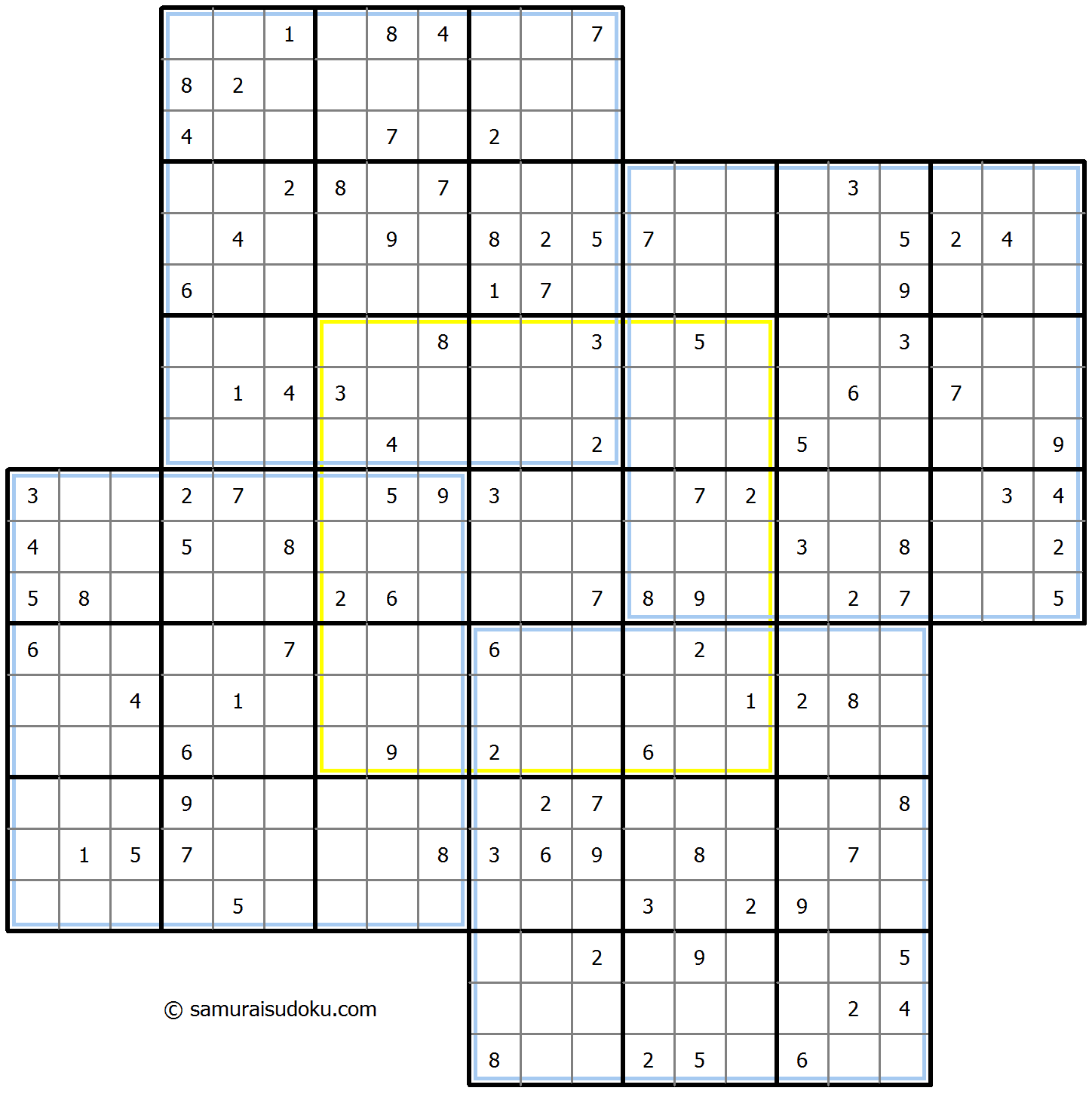
Example picture: The yellow line frame is the center disk, observe its unique misalignment and overlap
Frequently Asked Questions (FAQ)
Q: What is the biggest difference between Windmill Sudoku and Samurai Sudoku?
A: The biggest difference is the overlapping area and location. The Samurai Sudoku has 1 3x3 square on each corner; the Windmill Sudoku is a "dislocation" overlap, with two 3x3 squares on each outer disk and the central disk (a total of 18 squares), thus forming a rotationally symmetrical pinwheel shape.
Q: Are there any special rules for the 3x3 grid in the center that does not overlap with other boards?
A: No special rules. It is just an ordinary 3x3 grid at the core of the central 9x9 board. But precisely because the eight peripheral palace grids are shared by the outer disk, this central independent palace grid often becomes the "terminal station" for collecting clues that are excluded from all directions, and is a key area for connecting the previous and the next when solving problems.
Play Windmill Sudoku
Browse all puzzles or start with this sample puzzle.
English | 中文(简体) | 中文(繁體) | 日本語 | 한국어 | Français | Deutsch | Español | Português | Русский | Italiano | Nederlands | Türkçe | हिन्दी | ไทย | Tiếng Việt | Bahasa Indonesia | Polski | Українська |
数独 | Cool Sudoku | 数独 | Sudoku Puzzle | 賢くなるパズル | Free Printable Sudoku Puzzles
© samuraisudoku.com All rights reserved 2019-2026