
W Sudoku - Rules & Guide
What is W-Sudoku?
W-Sudoku is a very interesting variant of chained multi-disk puzzles. As the name suggests, it consists of 5 standard 9x9 classic Sudoku grids, which are spliced together in a diagonal overlapping manner, giving the overall appearance of a giant wavy English letter "W".
These 5 Sudoku boards are not independent, they are interlocking like a folded iron chain. You must reason about these 5 boards as an indivisible linked whole, because the overlapping grids between adjacent boards are the key hub for you to advance the progress of solving problems.
Basic rules
- Standard Sudoku Rules: The entire "W" shaped puzzle can be split into 5 complete 9x9 sub-Sudoku boards. You must ensure that each of the 5 sub-disks contains the numbers 1 to 9 in each row, column and 3x3 thick-line grid without repetition.
- Chained Single Palace Grid Overlap: These 5 disks are arranged in the order of "upper left - lower left - upper middle - lower right - upper right". Each two adjacent boards overlap at opposite corners 1 3x3 square (containing 9 squares). Any number filled in these overlapping areas must simultaneously and absolutely satisfy the dual rule constraints of the two boards it spans.
- (Note: The two disks at both ends of the entire chain have only one overlap each; while the three middle disks at the corners each have two overlaps.)
How to solve problems and practical skills
Tip 1: “Chain derivation” by following the clues
Because the entire puzzle is a long linear chain, the clues will be passed along like dominoes. When you find a breakthrough on the leftmost disk, you can pass the determined number to the second disk through the overlapping grid, and then to the middle disk. Try to follow the direction of the "W" fold line to find clues, and don't blindly stick to the isolated board without any known numbers.
Tip 2: The three middle disks are information transfer stations
The three middle disks located at the corners of the "W" shape are very special. They each have two overlapping grids, which means that they are simultaneously flanked and "blood transfused" by the adjacent disks on the left and right sides. When you fill in the numbers on these intermediate disks, be sure to use long line repulsion and check whether the two disks it connects will constrain it.
Tip 3: The penetrating power of long-term repulsion
Although adjacent boards overlap by only one square, the repulsive force of numbers in standard Sudoku can penetrate along an entire straight line. This means that for a known number at the far end of the disk, its repulsive rays can penetrate the overlapping grids in a straight line, thereby helping adjacent disks to squeeze out unique candidates. When you get stuck, remember to lengthen your sight and see if there are any hidden repulsion points on the long straight line that runs through the two disks.
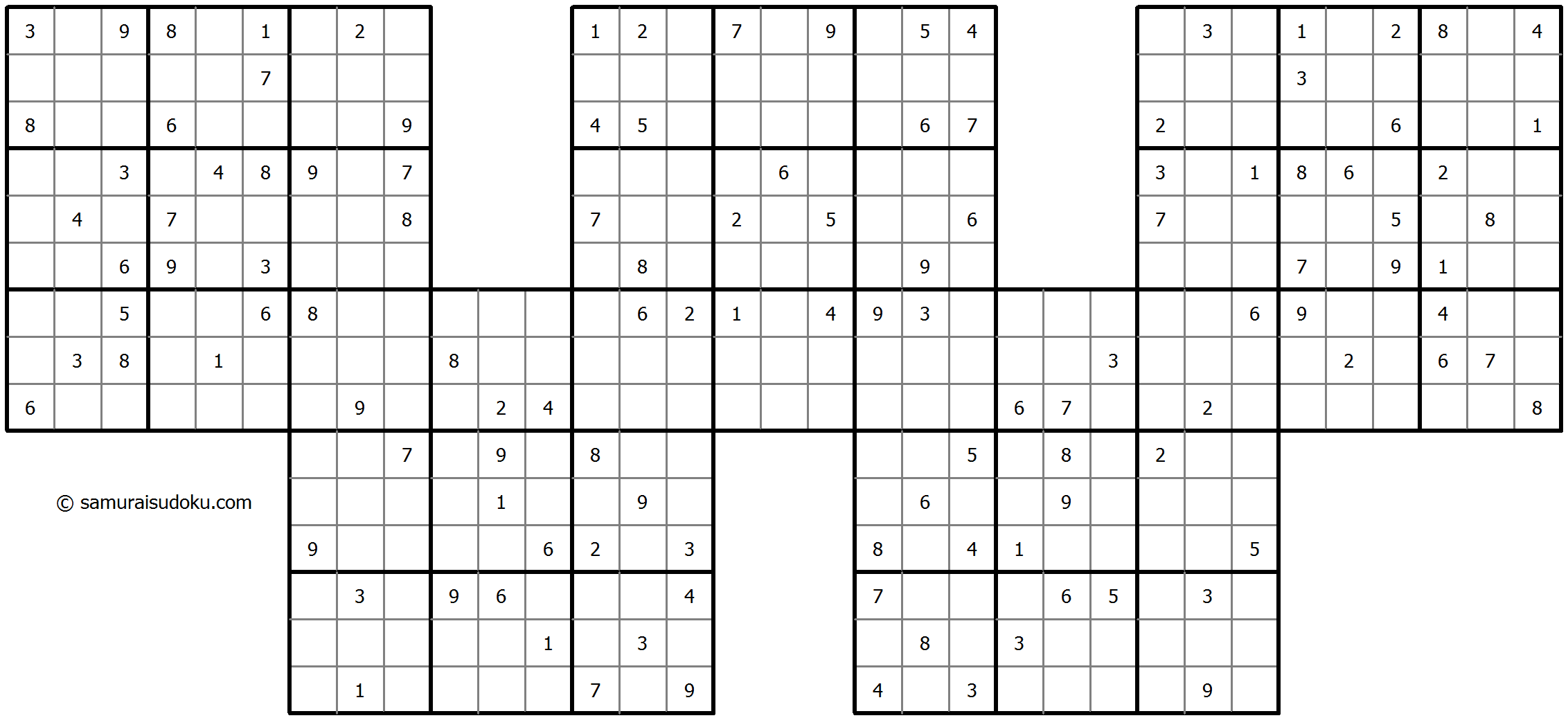
Example picture: observe the 5 disks arranged in a "W" shape and their 4 overlapping grids at the opposite corners
Frequently Asked Questions (FAQ)
Q: What is the difference between W Sudoku and Samurai Sudoku?
A: They are both composed of 5 disks, and the overlap of adjacent disks is exactly the same (one diagonal grid overlaps). The core difference lies in the formation layout: Samurai Sudoku is a "cross" type, and the central disk is extremely important (withstands four overlapping sides); while W Sudoku is a "linear chain" type, with no absolute core, and the transmission of clues is like a wavy line, with more emphasis on sequential and coherent derivation from one end to the other.
Q: Is there a primary or secondary distinction between these 5 disks? Which one should I solve first?
A: There is no priority, their status is almost equal. However, in actual problem solving, usually the initial known numbers at the far left or right end of the board are relatively dense and are suitable as the first entry point. Once you open a gap in a certain section, you can follow the W-shaped fold line to deduce the clues to the other end like a zipper.
Play W Sudoku
Browse all puzzles or start with this sample puzzle.
English | 中文(简体) | 中文(繁體) | 日本語 | 한국어 | Français | Deutsch | Español | Português | Русский | Italiano | Nederlands | Türkçe | हिन्दी | ไทย | Tiếng Việt | Bahasa Indonesia | Polski | Українська |
数独 | Cool Sudoku | 数独 | Sudoku Puzzle | 賢くなるパズル | Free Printable Sudoku Puzzles
© samuraisudoku.com All rights reserved 2019-2026