
Twodoku - Rules & Guide
What is Twodoku?
Twodoku is one of the most basic and classic variations of multi-disk splicing Sudoku. As the name suggests, it is composed of 2 standard 9x9 classic Sudoku grids (usually arranged diagonally).
The two separate sudokus are cleverly locked together by overlapping at the corners. You have to solve them as a connected whole because they share some extremely critical clues.
Basic rules
- Standard Sudoku rules: The puzzle consists of 2 complete 9x9 sub-Sudoku boards (the upper left board and the lower right board in the picture). You must make sure that each of the 2 sub-disks contains the numbers 1 to 9 in each row, column and 3x3 thick grid without repetition.
- Single grid overlapping sharing: The 3x3 grid in the lower right corner of the upper left panel is also the 3x3 grid in the upper left corner of the lower right panel. Any number filled in this 9-square overlapping area must absolutely satisfy the rule constraints of the two Sudoku boards at the same time, and there must be no conflict.
How to solve problems and practical skills
Tip 1: Think of overlap areas as “information bridges”
The only 3x3 overlapping palace grid (9 grids) in the game is the only bridge connecting the two boards. When you derive a number on the upper left disk and fill in that field, it immediately becomes a known clue on the lower right disk; and vice versa. You need to constantly use this bridge to "transport" problem-solving ammunition between the two boards.
Tip 2: The penetrating power of long-term repulsion
Although there is only one square in the overlapping area, the repulsive force of the numbers can penetrate along a straight line. If you fill in a number "8" in a row on the upper left board (non-overlapping area), you have to look along this line to check whether it can repel the overlapping area, thereby indirectly helping you eliminate the candidate numbers in the corner of the lower right board.
Tip 3: "Switch sides" immediately when encountering a bottleneck
Because the initial clues were deliberately scattered between the two boards by the question maker, when you stare at the board in the upper left corner for a long time but make no progress, don't give in. This usually means that you need to solve the board in the lower right corner first, and "feed back" the clues derived from the lower right corner to the upper left corner through the overlapping squares in the middle in order to break the deadlock and move forward.
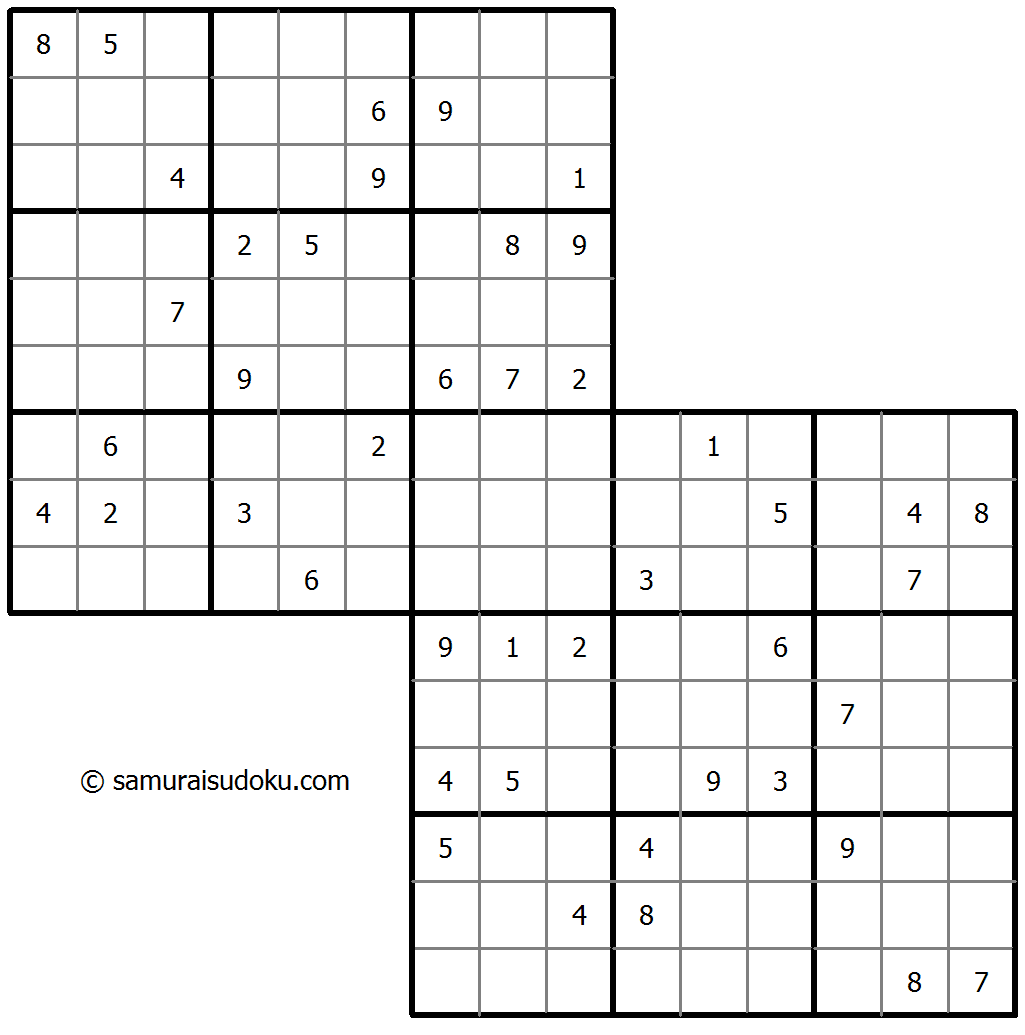
Example image: observe the 3x3 grid shared by two 9x9 disks in the corner
Frequently Asked Questions (FAQ)
Q: Can these two disks be unlocked independently?
A: No. Although they only overlap by 9 grids, these 9 grids are strictly bound. No single disk can be solved independently due to insufficient clues (sometimes even the overlapping area itself is completely empty at first). You must approach them both ways and treat them as a complete question.
Q: Who is more difficult than Samurai Sudoku?
A: Structurally speaking, Double Overlapping Sudoku (2 disks, 1 overlap) is like a "minimalist entry-level version" of Samurai Sudoku (5 disks, 4 overlaps). Their diagonal overlapping principles are completely consistent, so double overlapping Sudoku is very suitable for practicing and familiarizing yourself with the problem-solving thinking of multi-disk linkage exclusion.
Play Twodoku
Browse all puzzles or start with this sample puzzle.
English | 中文(简体) | 中文(繁體) | 日本語 | 한국어 | Français | Deutsch | Español | Português | Русский | Italiano | Nederlands | Türkçe | हिन्दी | ไทย | Tiếng Việt | Bahasa Indonesia | Polski | Українська |
数独 | Cool Sudoku | 数独 | Sudoku Puzzle | 賢くなるパズル | Free Printable Sudoku Puzzles
© samuraisudoku.com All rights reserved 2019-2026