
Twin Corresponding Sudoku - Rules & Guide
What is Twin Corresponding Sudoku?
Twin Corresponding Sudoku consists of two side-by-side, seemingly independent, standard 9x9 Sudoku boards on the left and right. On the surface, they do not overlap with each other, but in fact, their final answers are logically locked together by an extremely clever"digital password mapping".
There is a one-to-one correspondence between numbers (i.e. password shuffling) between the two Sudoku solutions. For example, if all "1"s on the left side of the disk correspond to "7" at the same position on the right side of the disk, then all "2"s on the left side must correspond to another fixed number (such as "4") on the right side, and this mapping is two-way binding and unique.
Basic rules
- Standard Sudoku rules: You must ensure that each of the left and right 2 sub-boards, each row, each column and each 3x3 thick-line grid inside it, contains the numbers 1 to 9 without repetition.
- One-to-one mapping (core rule): There is a perfect one-to-one "codebook" for the numbers 1 to 9. Assume that the answer to the left disk at a certain grid
(xth row, yth column)is the numberA, and the answer to the right disk at the exact same coordinates(xth row, yth column)is the numberB. This means that a pair of mappingsA on the left ↔ B on the rightis established. - Full Disk Isomorphism Replacement: Once a certain pair of mappings
Left A ↔ Right Bis established through reasoning, then all the grids on the left disk that are filled withAmust be filled withBat the same coordinate positions on the right disk; vice versa, allBon the right disk must be filled withAat the same coordinate positions on the left side.
How to solve problems and practical skills
Tip 1: Find the "deciphering point" to establish a codebook
The first step in solving the problem is not to crazyly deduce a single disk, but to establish a "codebook". If you use basic Sudoku skills to solve the answer to a certain grid on the left side of the board (assuming it is 3), and at the same time you find that the grid with the same coordinates on the right side of the board happens to be the given known clue 8, congratulations, you have cracked the first password: Left 3 ↔ Right 8! Quickly write down this mapping relationship on paper.
Tip 2: Use the codebook for "cross-border airdrop"
This is the most enjoyable part of this variant. Once you master the password of Left 3 ↔ Right 8, you can immediately convert all known or deduced "3" on the left side of the disk into "8" at the corresponding coordinate position on the right side; at the same time, convert all "8" on the right side into "3" at the corresponding position on the left side. This is equivalent to two boards "airdropping" known clues to each other, which can break the deadlock instantly!
Tip 3: Trial and error lightning protection with dual-disk mirroring
Sometimes you can't directly get the number of a grid, but you can use the mapping relationship to eliminate candidate numbers. For example: you guess that a certain cell on the left may be 5. According to the codebook you already have, Left 5 corresponds to Right 9. But you take a look at the same coordinates on the right side of the disk and find that the counterpart or house in that position already has a 9, causing a conflict. This means that 9 cannot be filled in on the right, so the square on the left cannot be 5! This method of using "mirror clones" to cross mine is extremely efficient.
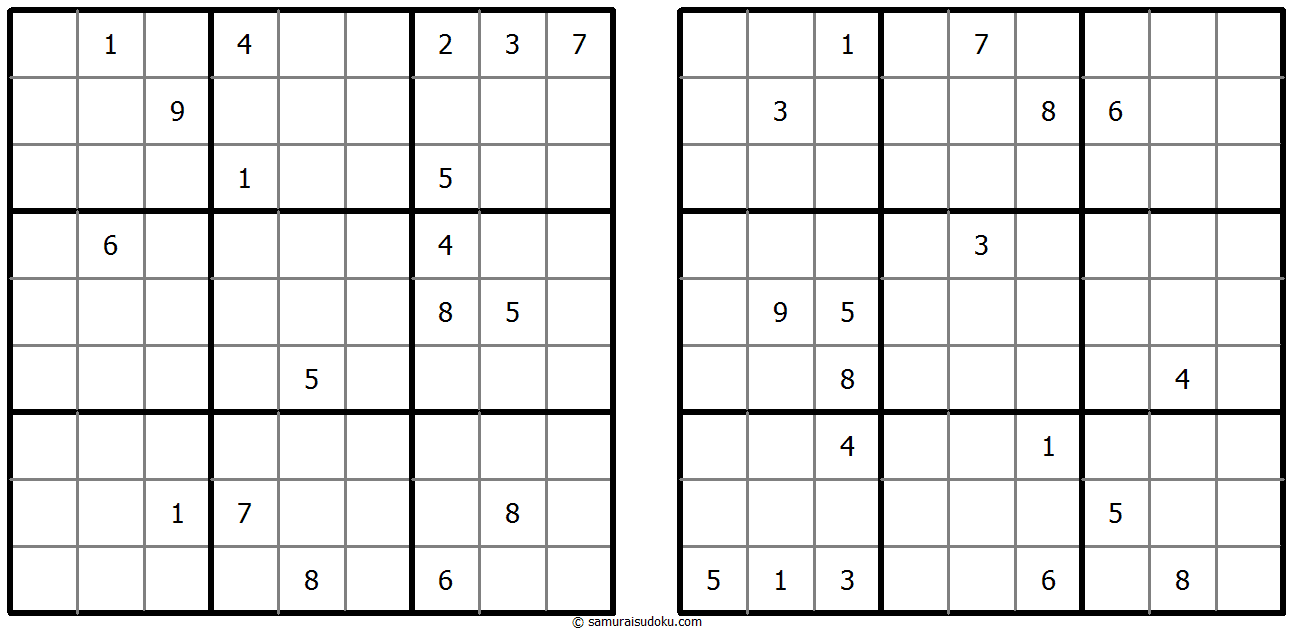
Example picture: The coordinates of the left and right disks are completely consistent, and there is a unique global mapping relationship between the numbers
Frequently Asked Questions (FAQ)
Q: If the "1" on the left corresponds to the "5" on the right, does that mean the "1" on the right also corresponds to the "5" on the left?
A: Not necessarily! "One-to-one correspondence" means: the left set {1 to 9} is reshuffled as a whole and mapped to the right set {1 to 9}. If Left 1 → Right 5, then Right 5 → Left 1 is absolutely true. However, the 1 on the right will correspond to who on the left, and you need to decipher it separately. It may correspond to left 7, or it may exactly correspond to left 5 (but this is not necessary).
Q: Can I completely ignore the right side of the board and solve the left side of the board based on known clues?
A: Absolutely impossible. When designing the question, the question maker deliberately "encrypted" the key clues needed to pass the level and divided them into two boards. There are too few known numbers for any single disk, and relying on a single disk will definitely lead to failure. You have to create a codebook, "translate" back and forth between the two boards and carry clues to each other before you can finally piece together the complete solution.
Play Twin Corresponding Sudoku
Browse all puzzles or start with this sample puzzle.
English | 中文(简体) | 中文(繁體) | 日本語 | 한국어 | Français | Deutsch | Español | Português | Русский | Italiano | Nederlands | Türkçe | हिन्दी | ไทย | Tiếng Việt | Bahasa Indonesia | Polski | Українська |
数独 | Cool Sudoku | 数独 | Sudoku Puzzle | 賢くなるパズル | Free Printable Sudoku Puzzles
© samuraisudoku.com All rights reserved 2019-2026