
Triple Doku - Rules & Guide
What is Triple Doku?
Triple Doku is a conjoined puzzle composed of 3 standard 9x9 classic Sudoku grids. These three disks are arranged along the diagonal direction like stairs, and are connected end to end to create a large area of overlap.
Unlike ordinary single Sudoku, due to the deep interlocking between the boards, you cannot separate any sub-board to solve it independently. They must be regarded as a linked whole, and clues must be passed back and forth among the three boards to finally obtain the correct and unique solution.
Basic rules
- Standard Sudoku rules: The entire ladder-shaped puzzle consists of 3 complete 9x9 sub-Sudoku boards. You must make sure that each of the 3 sub-disks contains the numbers 1 to 9 in each row, column and 3x3 thick grid without repetition.
- Horizontal area overlapping sharing: Two adjacent 9x9 disks (i.e., upper left and middle, middle and lower right) each share a 6x3 rectangular area (i.e., two 3x3 grids connected horizontally). The numbers filled in these 18 overlapping areas must simultaneously and absolutely satisfy the double rule constraints of the two boards it spans.
How to solve problems and practical skills
Tip 1: Grasp the overlapping "joints"
Since the two overlapping areas are both 6-block rectangles, they are like "skeletal joints" connecting the three disks. Any number filled in the joint area will emit extremely strong repulsive rays to the upper and lower disks at the same time (triggering row or column exclusion across the disks). Prioritizing finding logical breakthroughs in these overlapping areas can greatly speed up problem solving.
Technique 2: The hub ferry function of the center disk
The second 9x9 board in the center is the most critical communication hub. Its top 2 squares overlap with the upper left disk, and its bottom 2 squares overlap with the lower right disk. When you find that the boards at either end are stuck, try to focus on breaking through the middle board, through which you can safely "ferry" the clues to the other end of the puzzle.
Tip 3: Don’t look behind the curtain
Although the disk is composed of three well-known 9x9 boxes, when dealing with overlapping areas, never limit the field of view to a certain current box. You must develop the habit of scanning across the board: if you are going to fill in a number "5" in the overlapping area of the middle disk, you must look along the dotted line of the row or column and check whether there is already a "5" at the far end of the disk in the upper left corner or lower right corner.
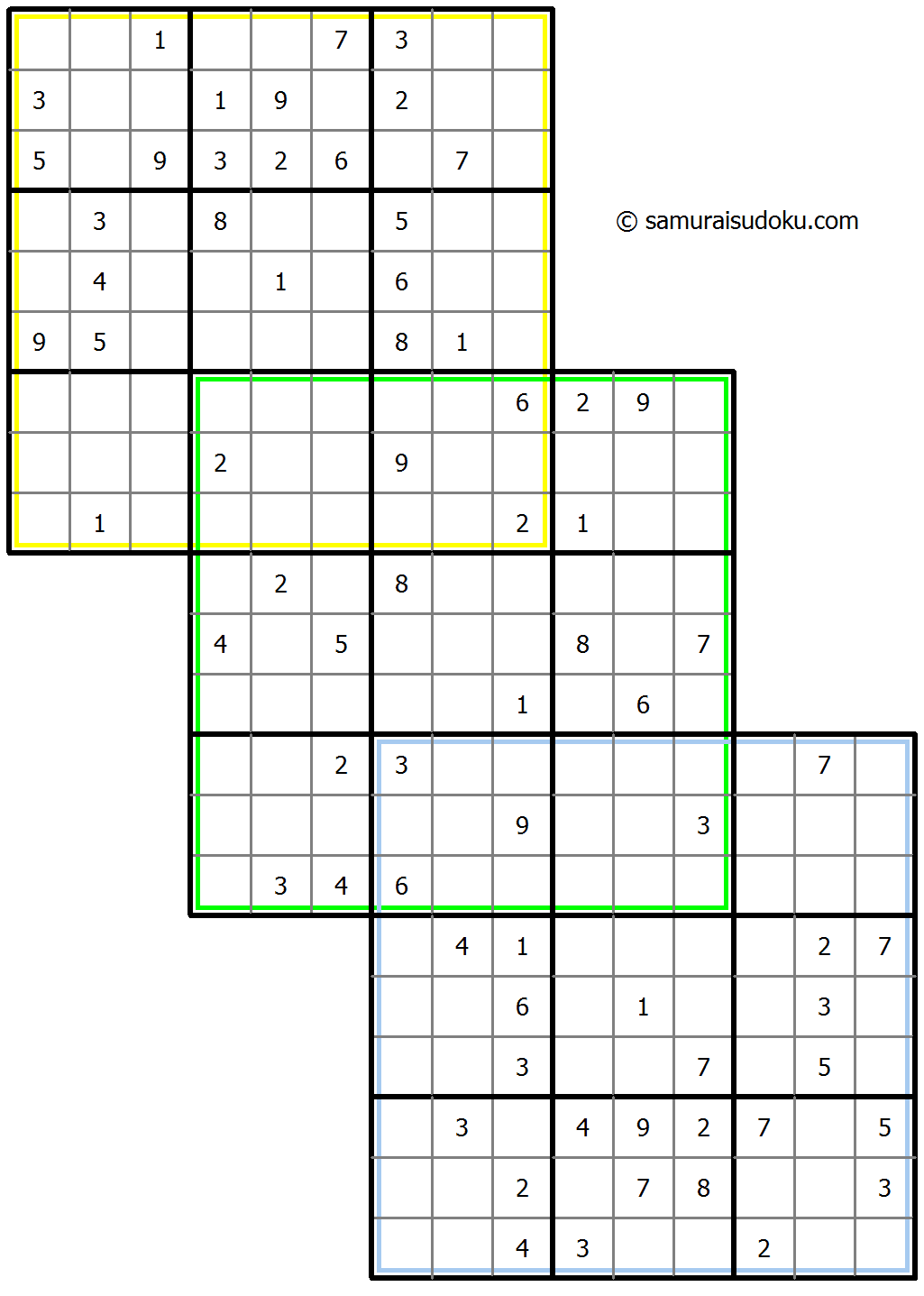
Example picture: observe the stepped arrangement of the three disks and the rectangular overlapping area
Frequently Asked Questions (FAQ)
Q: Are the overlapping areas of these three disks the same?
A: It's the same. The overlapping areas of the upper left disk and the middle disk, and the middle disk and the lower right disk are exactly the same size. They are all composed of two 3x3 grids arranged horizontally, that is, a rectangular area (containing 18 grids) that is 6 grids wide and 3 grids high.
Q: Is there a direct relationship between the top disk and the bottom disk?
A: They do not have any overlap in space and are independent of each other. But since they all deeply overlap with the middle disk, the middle disk actually acts as a communication bridge between them. The information you get on the top disk often indirectly triggers a chain reaction on the bottom disk through the middle area.
Play Triple Doku
Browse all puzzles or start with this sample puzzle.
English | 中文(简体) | 中文(繁體) | 日本語 | 한국어 | Français | Deutsch | Español | Português | Русский | Italiano | Nederlands | Türkçe | हिन्दी | ไทย | Tiếng Việt | Bahasa Indonesia | Polski | Українська |
数独 | Cool Sudoku | 数独 | Sudoku Puzzle | 賢くなるパズル | Free Printable Sudoku Puzzles
© samuraisudoku.com All rights reserved 2019-2026