
Flower Sudoku - Rules & Guide
What is Flower Sudoku?
Flower Sudoku is visually and structurally very similar to the classic "Samurai Sudoku", which is also composed of five standard 9x9 Sudoku boards. But in Flower Sudoku, the overlap between the disks is much deeper!
In ordinary Samurai Sudoku, only the 3x3 grids on the four corners overlap; in Flower Sudoku, the four outer Sudoku are deeply "embedded" into the central Sudoku (the overlapping area is up to 6x6). This leads to a strange visual phenomenon: the 5th Sudoku puzzle in the center (shaded green in the picture) is completely covered by the 4 surrounding sub-puzzles! The entire shape resembles a blooming flower, hence the name.
Basic rules
- Standard Sudoku Rules: Since the entire puzzle is composed of 5 complete 9x9 sub-Sudokus, you must ensure that every row, column and 3x3 thick-line grid within each 9x9 sub-board contains the numbers 1 to 9 without repetition.
- Deep overlap sharing: The four peripheral disks overlap the central disk in a large area. Each number located in the overlapping area must simultaneously satisfy the rule constraints of all 9x9 sub-boards to which it belongs, and must not cause a conflict in any one board.
How to solve problems and practical skills
Tip 1: Keep an eye on the center 3x3 grid (stamen)
The 3x3 thick line grid in the center of the entire flower Sudoku board is the core "crossroads" of the entire game. Due to the overlap in depth, the 9 grids in this palace grid belong to all 5 9x9 Sudoku boards at the same time! This means that these 9 grids are subject to the strongest horizontal, vertical and palace repulsive forces, and usually you can find the most logical breakthroughs here.
Tip 2: Take advantage of edge-unique zone “crossfire” exclusion
Although the four outer sudokus overlap deeply inward, their respective 3 columns/3 rows extending outward (the non-overlapping parts) are unique. When you are stuck in a large overlapping area, you might as well look to the periphery and sweep the known numbers on the periphery into the central overlapping area like "rays". Using the crossfire of rows and columns can often squeeze out unique candidates.
Technique 3: Regional linkage (chain reaction)
Because the overlapping area is very large (6x6), the determination of a number will spread quickly like a water wave. A number you solve in the Sudoku in the upper left corner may directly determine the value of a certain grid in the Sudoku in the center, and then instantly affect the Sudoku in the lower right corner. So don’t just stare at a partial 9x9 disk, always raise your vision and observe the linkage constraints between the five overall disks.
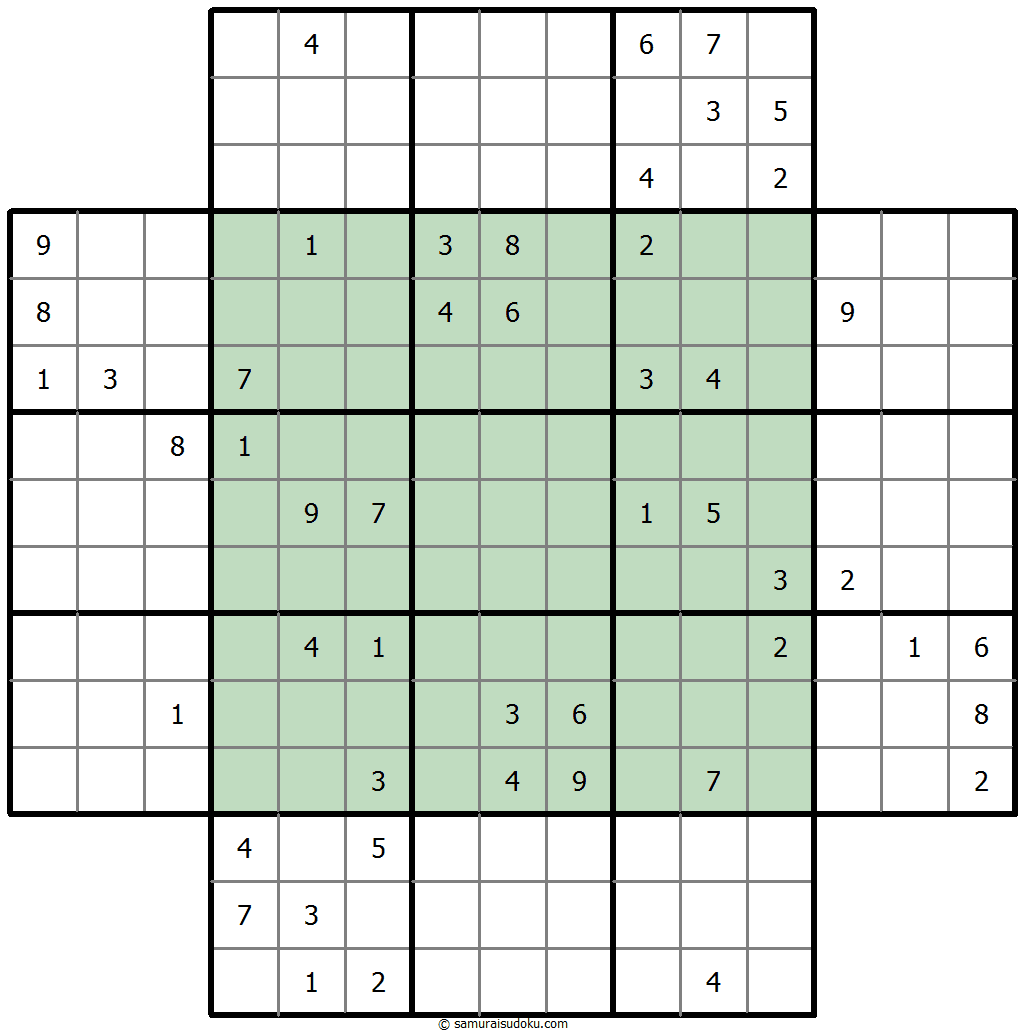
Example image: The green part is the central 9x9 disk that is completely covered by the four peripheral disks
Frequently Asked Questions (FAQ)
Q: Is the central 3x3 grid of Flower Sudoku really shared by 5 boards?
A: Yes! The central 3x3 grid of the green central disk not only belongs to the central 9x9 disk, but also happens to be the internal grid of the four peripheral 9x9 disks: upper left, upper right, lower left, and lower right. Therefore, the numbers filled in here are subject to the most stringent rules from all directions.
Q: Are there any special rules for the green shaded part in the picture?
A: The green shading is just to help you visually distinguish the fifth 9x9 Sudoku board "hidden in the center". It does not have any additional or special additional rules. You need to treat the four peripheral disks just like you do, just make sure that this green 9x9 area also meets the standard Sudoku rules of peers, columns, and palaces without duplication.
Play Flower Sudoku
Browse all puzzles or start with this sample puzzle.
English | 中文(简体) | 中文(繁體) | 日本語 | 한국어 | Français | Deutsch | Español | Português | Русский | Italiano | Nederlands | Türkçe | हिन्दी | ไทย | Tiếng Việt | Bahasa Indonesia | Polski | Українська |
数独 | Cool Sudoku | 数独 | Sudoku Puzzle | 賢くなるパズル | Free Printable Sudoku Puzzles
© samuraisudoku.com All rights reserved 2019-2026