Cross Sudoku - Rules & Guide
What is Cross Sudoku?
Cross Sudoku is named after its appearance that resembles a huge "ten" (or plus sign). It's made from 5 standard 9x9 classic Sudoku grids: one in the center and four directly above, below, left and right of it.
These five disks are not simply edge-to-edge splicing, but extremely deep interlocking. The entire outer circle of the central disk is "occupied" by the peripheral disks. What's even more amazing is that this leads to an overlap between the two adjacent disks on the periphery (such as the upper disk and the left disk), forming a super linkage network that affects the whole body.
Basic rules
- Standard Sudoku rules: The entire cross-shaped puzzle consists of 5 complete 9x9 sub-Sudoku boards. You must ensure that each of the 5 sub-disks contains the numbers 1 to 9 in each row, column and 3x3 thick-line grid without repetition.
- Triple Shared Super Corners: The 3x3 squares on the four corners of the central 9x9 board are the most special. For example, the palace grid in the upper left corner not only belongs to the central disk, but is also the lower left corner of the upper disk and the upper right corner of the left disk. This means thatany number in these four corner grids must absolutely satisfy the rule constraints of 3 independent Sudoku boards at the same time!
- Double shared edges: The four central edge grids on the top, bottom, left and right of the central disk overlap with the corresponding peripheral disks respectively. The numbers filled in must meet the non-duplication constraints of the two disks at the same time.
How to solve problems and practical skills
Tip 1: Prioritize bombing of the "triple core area"
The four corners of the central board (the four corners of the blue line frame in the picture) are the "super hub" of the entire game. The numbers filled in these four palace grids will be subject to strict scrutiny on the three disks at the same time. Because the repulsive force is the greatest and the number that can survive is the least, this is often the point where clues converge most intensively and it is easiest to use the elimination method to force out the only candidate number.
Technique 2: Derivation of the "cross" on the center disk
Out of the 9 squares in the central disk, 8 are shared by the peripheral disks, but the most central square is completely independent. When you unlock the numbers on the surrounding outer disks, the numbers will cut straight into the center disk like a cross lightsaber. Using the four "wings" on the periphery to cover the center with crossfire can quickly force the center to surrender.
Tip 3: Cut off independent market thinking
In Cross Sudoku, adjacent peripheral boards (such as above and left) create direct physical overlap through the central corners, a feature not found in most other variations (such as Samurai Sudoku). When you get stuck solving a puzzle on the upper board, you can go directly to the left or right board to look for clues. Because they are "directly adjacent" conjoined twins, they must not be treated as isolated Sudokus.
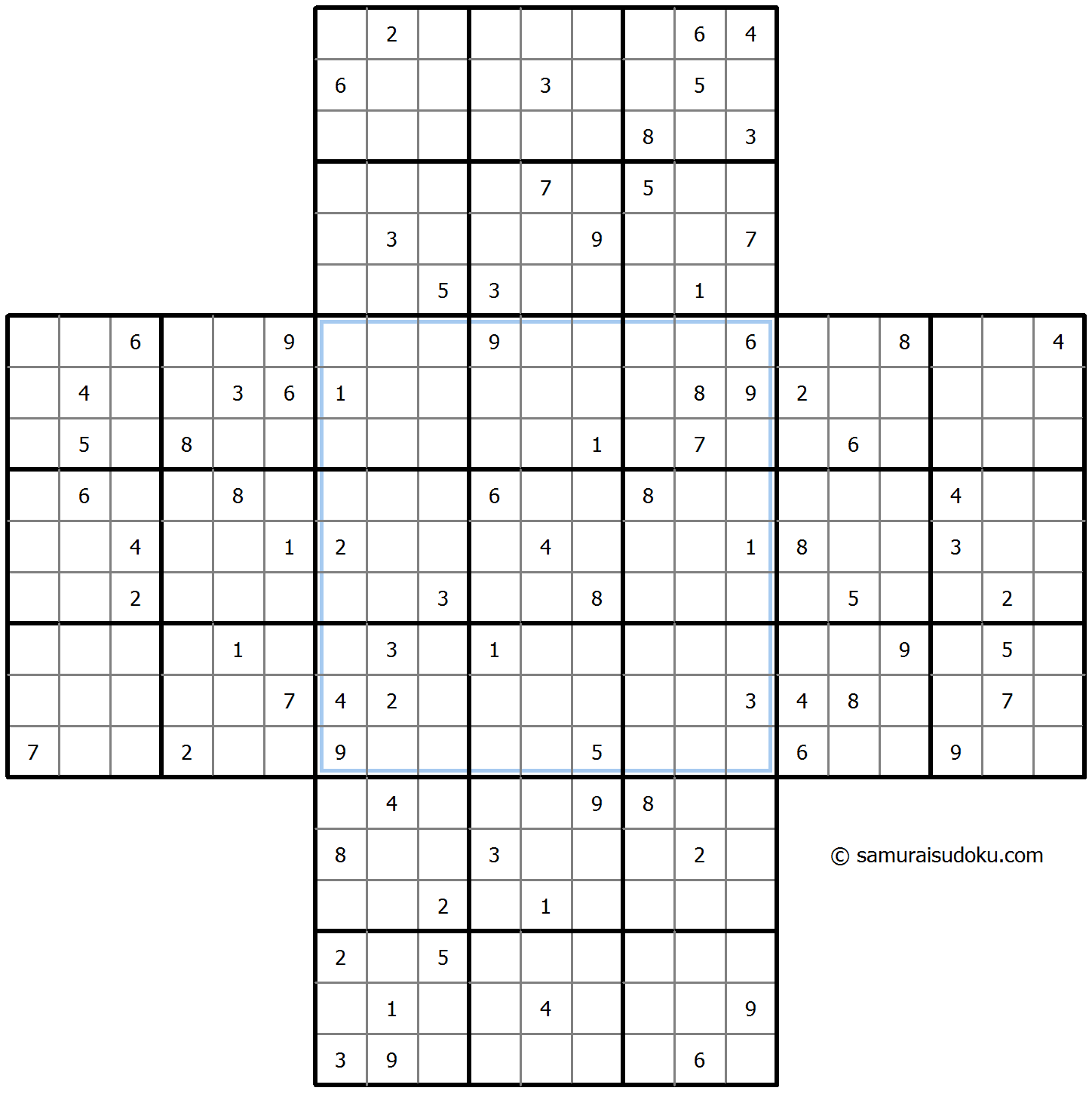
Example image: The blue wireframe is the central disk, observe the "triple overlap" at its four corners
Frequently Asked Questions (FAQ)
Q: Are there any special rules for the area enclosed by the blue border in the picture?
A: The blue border is just to visually help you clearly mark the 9x9 Sudoku board in the center. It does not have any additional rules. You simply need to make sure that every row, column, and palace in the blue box meets the basic Sudoku rules of 1-9 without repetition.
Q: What is the difference between Cross Sudoku and Samurai Sudoku?
A: The difference is huge! In Samurai Sudoku, the central disk overlaps the four peripheral disks "diagonally" without any contact between the peripheral disks. The cross Sudoku is "welded" overlapping up, down, left and right. This results in the fact that the four squares in the central corners of the Cross Sudoku are "shared by three disks", and there is also a direct overlap between adjacent peripheral disks (such as the top and left), making the involvement even closer and more complicated.
Play Cross Sudoku
Browse all puzzles or start with this sample puzzle.
English | 中文(简体) | 中文(繁體) | 日本語 | 한국어 | Français | Deutsch | Español | Português | Русский | Italiano | Nederlands | Türkçe | हिन्दी | ไทย | Tiếng Việt | Bahasa Indonesia | Polski | Українська |
数独 | Cool Sudoku | 数独 | Sudoku Puzzle | 賢くなるパズル | Free Printable Sudoku Puzzles
© samuraisudoku.com All rights reserved 2019-2026