
Clueless Sudoku 1 - Rules & Guide
What is Clueless Sudoku 1?
Although its name is "Boring Sudoku", it's actually a huge variation that's extremely creative and challenging! Its disk is extremely large and consists of 9 standard 9x9 classic Sudoku grids that are completely non-overlapping and present a large 3x3 matrix as a whole.
It would be really "boring" if there were just 9 independent Sudokus to play individually. Its subtlety lies in the fact that among these 9 unrelated boards,there is a 10th Sudoku that spans the whole world and is cleverly hidden!
Basic rules
- Nine Independent Sudoku: The entire board contains 9 complete 9x9 sub-Sudokus. You must ensure that each of the 9 sub-disks contains the numbers 1 to 9 in each row, column and 3x3 thick-line grid without repetition.
- Hidden 10th Sudoku: Among all 81 3x3 squares on the entire board, there is a square marked with a specific color (such as the light blue square in the picture) in the center of each square. These 81 color grids scattered in every corner of the venue together form the 10th 9x9 Sudoku in the virtual space!
- Hidden Sudoku Rules: As the 10th Sudoku, these 81 color grids must also follow the rules of standard Sudoku:
- For 9 color grids in the same horizontal row, the numbers 1-9 must appear exactly once each.
- For 9 color grids in the same vertical column, the numbers 1-9 must appear exactly once each.
- The most important point: among the 9 color grids located on the same 9x9 independent disk (just forming a hidden 3x3 palace grid), the numbers 1-9 must not be repeated!
How to solve problems and practical skills
Tip 1: Treat the color grid as a "cross-sea bridge"
Since these 9 boards are not physically in contact with each other (no overlapping areas), the color grid is the only way you can pass clues across the boards. When you solve the number of the central color grid in a certain local disk, you must immediately bring it into the logic of the "10th Sudoku" to see if you can eliminate the candidates for the center grid of other disks through global hidden rows or columns.
Tip 2: Always keep in mind the "hidden palace constraints within a single chart"
Many players forget to hide the core "grid" rule of Sudoku when solving problems: in any single 9x9 board, its 9 colored center grids exactly constitute a 3x3 grid of the 10th Sudoku. This means that in these 9 specific cells, 1 to 9 must appear exactly once each. If you hit a dead end when solving a certain board, you might as well count the missing numbers in its nine color grids. This can often bring you back to life.
Tip 3: Run two parallel lines and switch perspectives at any time
To do this question, you need to have an extremely flexible dual perspective. You have to constantly switch back and forth between "single board classic Sudoku mode" and "full field color grid Sudoku mode". When the clues on a single board are exhausted and you can no longer push, raise your perspective to see the color grids scattered throughout the field; when the global clues are interrupted, focus back on a specific local board and dig deeper.
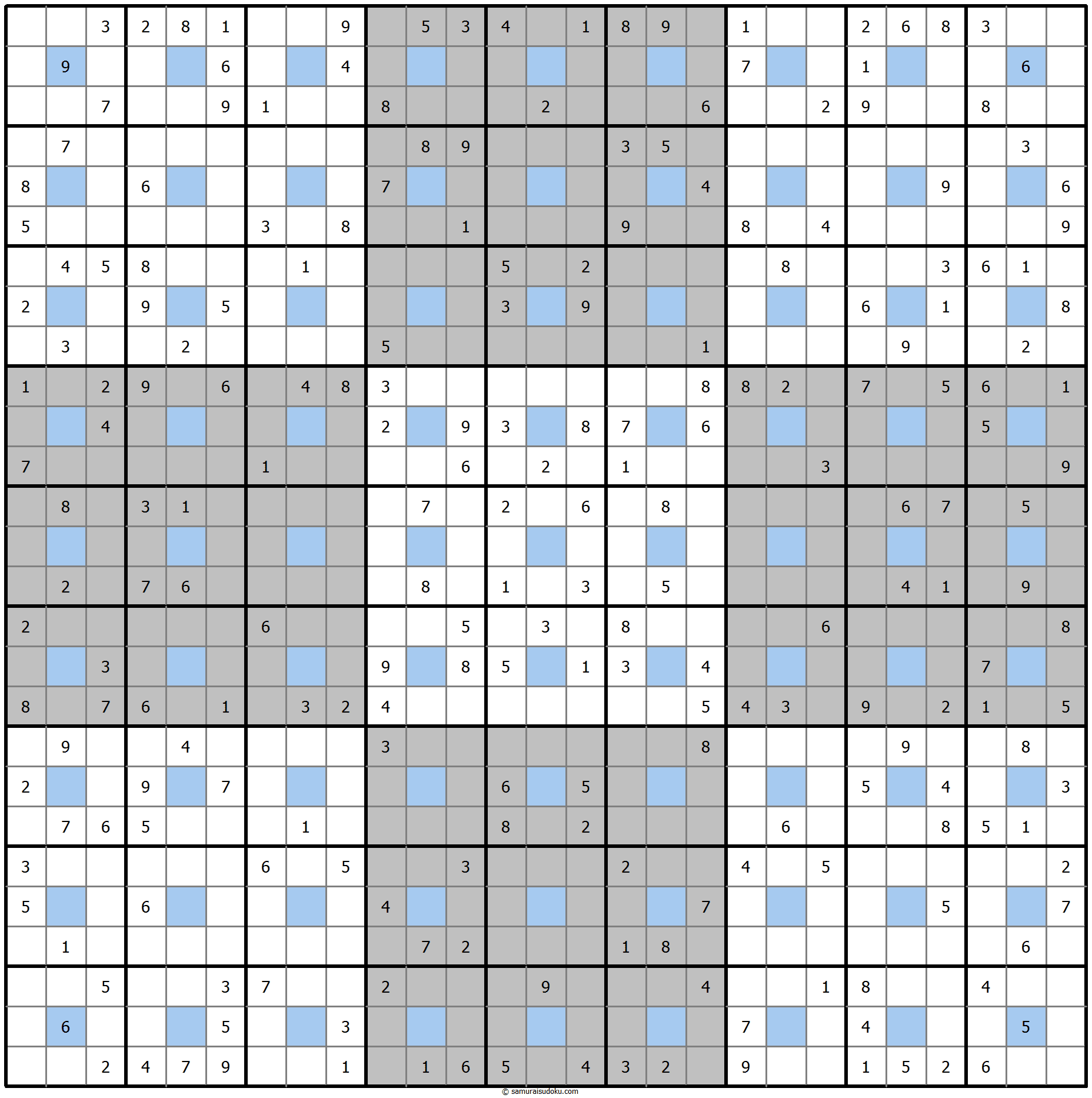
Example picture: observe 9 completely non-overlapping disks, as well as specific color grids scattered throughout the field (the 10th Sudoku)
Frequently Asked Questions (FAQ)
Q: Some of the 9x9 disks in the picture have white background and some are gray. Does this have any special meaning?
A: Does not have any special logical meaning. This is just to help you visually distinguish the boundaries of nine non-overlapping 9x9 disks to prevent misalignment of your vision. They appear alternately to form a checkerboard-like background pattern. You can completely ignore this large background color and only focus on the "small color grids" that really have linkage rules.
Q: Why is such a fun variant called "Clueless Sudoku"?
A: This is because in its original variant question, the initial known numbers given were extremely rare, and the players seemed clueless when they first got it, hence the name. But in the actual problem-solving process, by exploring the huge chain reaction brought about by the 10th hidden Sudoku, you will find that it is actually designed extremely exquisitely and is definitely not "boring" at all.
Play Clueless Sudoku 1
Browse all puzzles or start with this sample puzzle.
English | 中文(简体) | 中文(繁體) | 日本語 | 한국어 | Français | Deutsch | Español | Português | Русский | Italiano | Nederlands | Türkçe | हिन्दी | ไทย | Tiếng Việt | Bahasa Indonesia | Polski | Українська |
数独 | Cool Sudoku | 数独 | Sudoku Puzzle | 賢くなるパズル | Free Printable Sudoku Puzzles
© samuraisudoku.com All rights reserved 2019-2026